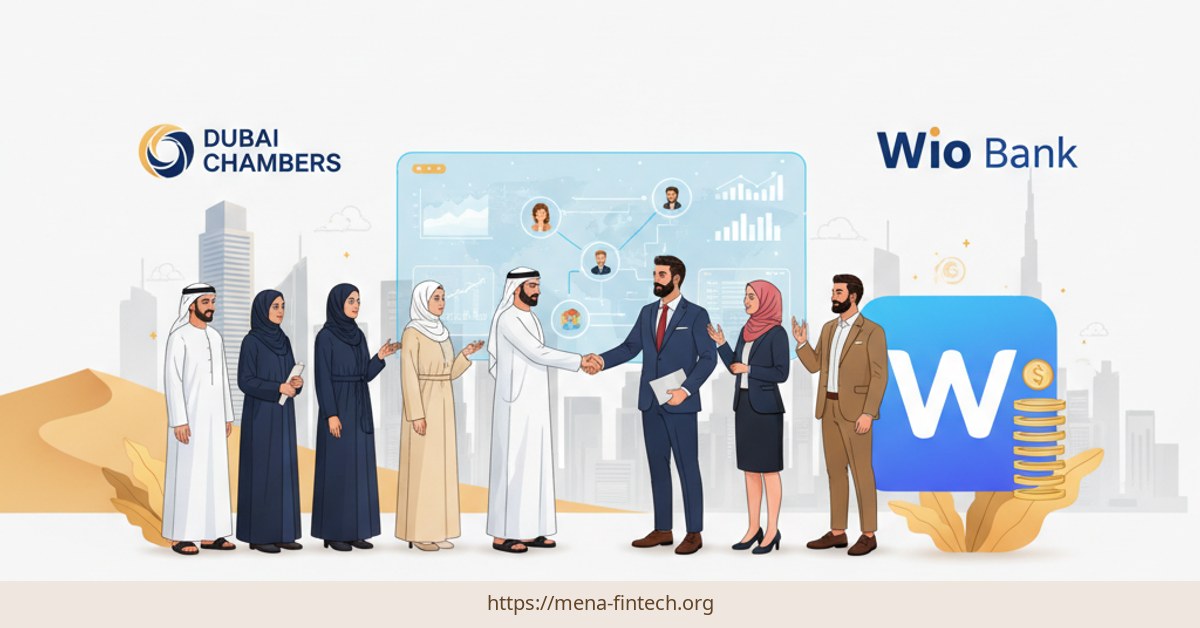
Dubai Chambers and Wio Bank have partnered to provide alternative banking services for SMEs.
Partnership Details
The collaboration aims to streamline access to business account opening and financing solutions. Dubai Chambers, a key economic institution in the UAE, and Wio Bank, a digital bank offering SME-focused services, will work together to reduce friction in SME banking. According to the Zawya report, the partnership will enable eligible merchants to access business accounts and financing through Geidea’s merchant network, with Wio Bank handling underwriting and regulatory compliance. The agreement was announced on 4 June 2026 and signed by Prateek Vahie, Chief Commercial Officer at Wio Bank, and Pankaj Kundra, CEO of Geidea UAE. Wio Bank’s financing options include credit lines of up to AED 250,000 with repayment windows of up to 90 days, which will now be extended through Geidea’s distribution channel.
Dubai Chambers, established in 1991, has long been a cornerstone of the UAE’s economic ecosystem, advocating for business-friendly policies and facilitating trade and investment. Its partnership with Wio Bank aligns with its mandate to support SMEs, which constitute over 90% of businesses in the UAE and contribute significantly to GDP and employment. Wio Bank, a digital-first institution, has previously focused on providing tailored financial solutions for SMEs, leveraging technology to simplify processes such as account opening and loan approvals. Geidea, a leading payment solutions provider in the region, operates a vast merchant network, enabling seamless integration of financial services into existing business operations. By combining these capabilities, the partnership seeks to address longstanding pain points for SMEs, including limited access to credit, cumbersome documentation, and fragmented financial ecosystems.
The model involves Geidea’s merchants accessing Wio Bank’s services through a streamlined onboarding process, with Wio Bank managing credit risk assessment and ensuring compliance with UAE financial regulations. This approach reduces the administrative burden on SMEs while enabling faster access to working capital. The credit lines offered—up to AED 250,000 with flexible repayment terms—reflect a focus on short-term liquidity needs, which are critical for SMEs navigating cash flow challenges.
Market Implications
This partnership reflects a broader trend in the MENA region to improve financial services for SMEs, which are critical to economic growth and diversification. By integrating payment infrastructure with banking and credit solutions, the model could influence how fintechs and banks in the region approach SME financing. However, the announcement did not disclose financial terms, expected merchant volumes, or regulatory approvals, leaving key details unresolved. For regional financial institutions, the practical question will be whether this infrastructure can translate into licensed, bank-compatible services across multiple jurisdictions.
The MENA region is home to over 30 million SMEs, which account for approximately 50% of the region’s GDP and employ more than 60% of the workforce. Despite their economic significance, SMEs in the region face systemic challenges, including limited access to formal credit, high operational costs, and fragmented financial ecosystems. According to the World Bank, only 30% of SMEs in the MENA region have access to formal financing, compared to 60% globally. This partnership addresses a critical gap by embedding financial services into existing merchant networks, thereby reducing the need for SMEs to engage with multiple intermediaries.
The embedded finance model—where banking tools are integrated into everyday business operations—has gained traction globally, particularly in markets with high mobile penetration and digital adoption. In the UAE, where 95% of the population uses mobile banking, this approach aligns with the country’s vision to become a global fintech hub. The collaboration between Dubai Chambers, Wio Bank, and Geidea could serve as a blueprint for similar initiatives across the GCC, where regulatory sandboxes and innovation labs are increasingly supporting fintech experimentation.
For banks, acquirers, and SME-focused fintechs across the region, the deal signals a shift toward embedded finance models that integrate banking tools into everyday business operations. This approach not only enhances customer convenience but also opens new revenue streams for financial institutions by capturing transactional data and offering value-added services. However, the success of such models hinges on regulatory alignment, technological interoperability, and the ability to scale across diverse markets with varying compliance requirements.
Significance:
For MENA fintech, the development highlights the convergence of payment infrastructure, digital banking, and working-capital access in the UAE. It also underscores the growing overlap between merchant platforms and financial services distribution. For banks, acquirers, and SME-focused fintechs across the region, the deal signals a shift toward embedded finance models that integrate banking tools into everyday business operations.
The partnership reinforces the UAE’s position as a regional leader in fintech innovation, particularly in addressing the needs of SMEs. By leveraging existing merchant networks, the model reduces the friction typically associated with onboarding SMEs into formal financial systems. This could catalyze broader adoption of digital banking solutions across the GCC, where governments are actively promoting financial inclusion through initiatives such as the UAE’s Vision 2021 and Saudi Arabia’s Vision 2030.
For market participants, the key challenge lies in scaling the model while navigating regulatory complexities. The absence of disclosed regulatory approvals raises questions about the partnership’s compliance with UAE Central Bank (CBUAE) guidelines, which require stringent oversight of digital banking services. Additionally, the lack of financial terms and merchant volume projections limits the ability to assess the partnership’s potential impact on the broader SME financing ecosystem.
What wasn’t disclosed:
The announcement did not specify investment size, ownership terms, regulatory approvals, named banking partners, launch markets, or committed transaction volumes. It also did not confirm when the first live corridor or product would move into production. These gaps highlight the need for further transparency to assess the partnership’s feasibility and scalability. For instance, the absence of named banking partners could indicate that the collaboration is still in its early stages, with potential for future expansion. Similarly, the lack of regulatory approvals may suggest that the partnership is awaiting final clearance from the CBUAE or other relevant authorities.
The undisclosed investment size and ownership terms could influence the long-term strategic direction of the partnership. If Wio Bank holds a minority stake in Geidea, for example, this might affect decision-making processes and the alignment of business objectives. Conversely, a majority stake could signal a more integrated approach to service delivery and customer acquisition.