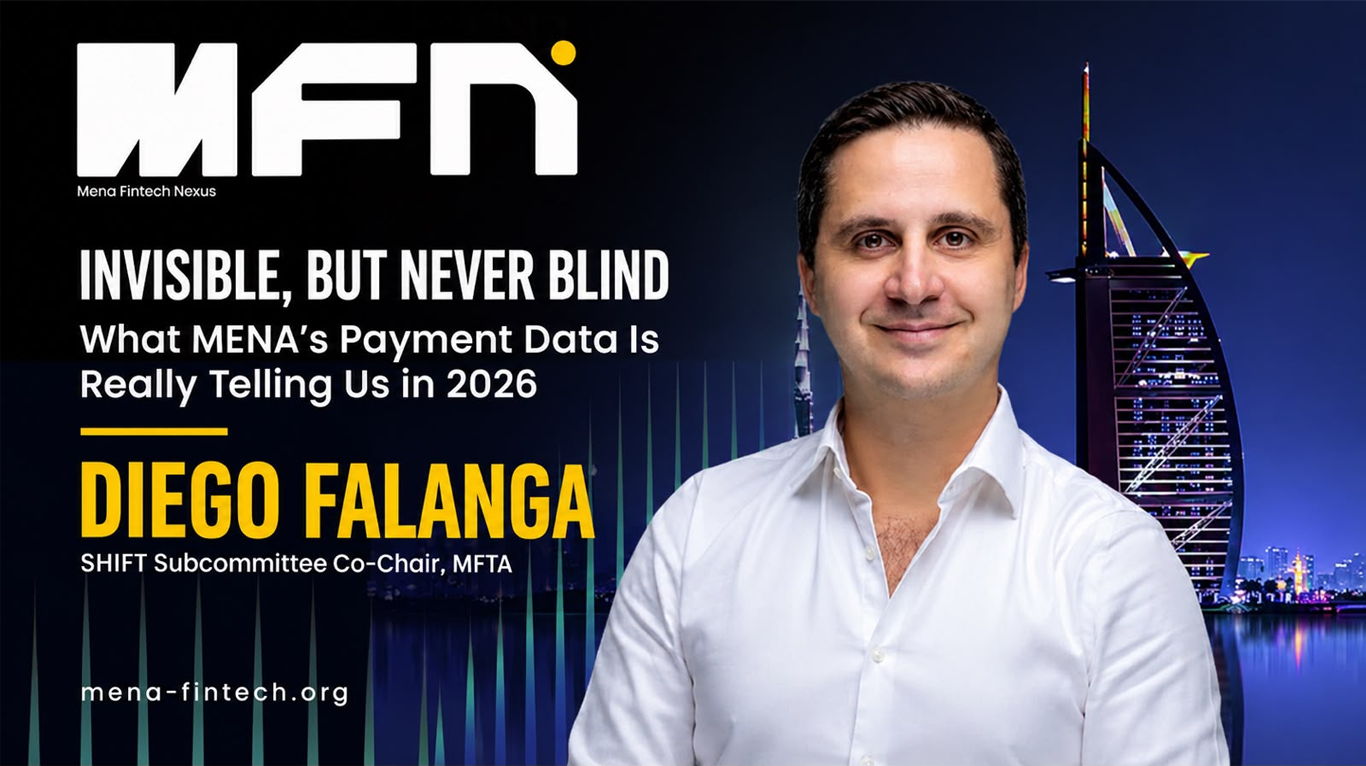
Reflections on Checkout.com’s MENA Digital Commerce 2026 report from someone whose daily focus is listening to merchants on the ground in the MENA region Diego Falanga
This article is by Diego Falanga, Director Sales – MENA at Checkout.com and Chair of MFTA’s SHIFT Payments Subcommittee “Gateways & Merchant Acceptance”. Diego works closely with merchants across the region on approval rates, local payment methods and getting ready for agentic commerce. Here he looks at Checkout.com’s MENA Digital Commerce 2026 report and what its numbers mean for anyone responsible for payments performance in MENA.
There’s a number in checkout.com 2026 MENA Digital Commerce report that I keep coming back to, because on its own it sounds like a mandate to strip everything out of the checkout: 97% of MENA consumers say it’s important that payments happen invisibly in the background with fewer screens, fewer prompts, no repeated authentication.
Then, a few pages later, there’s a number that sounds like the exact opposite instruction: 62% say a safe and secure payment process is important to them when buying online, more than those who prioritise guaranteed fast delivery (50%) or an easy returns process (54%). And 28% have abandoned a cart specifically because of security concerns. Not because it was slow. Because it felt unsafe.
Most of the conversations I have with merchants in this region start somewhere in the gap between those two numbers. And the honest answer is that they aren’t in conflict at all. Consumers in MENA are not asking for less security. They’re asking for security that doesn’t cost them anything, no friction, no extra screens, no re-entering a card they’ve used ten times before. Invisible, but never blind.
That distinction is, I’d argue, the single most important strategic idea in payments in this region right now. Because the market has moved past the point where digital adoption is the story.
The region has moved from adoption to execution
The growth is not in question. Checkout.com’s total processing volume in MENA grew 62% year-on-year in 2025. Across the region, 45% of consumers now shop online weekly or more often, and 63% expect to shop online more frequently over the next 12 months, rising to 73% in Qatar and 67% in both Saudi Arabia and the UAE.
But look at where that growth is actually concentrated, and you see a market that has stopped being ecommerce and started being infrastructure for daily life:
- Food delivery is now the region’s dominant online category, at 59% of consumers; 72% in Kuwait, 71% in Qatar. This is habitual, high-frequency, low-consideration spend. The payment has to disappear.
- Remittance volumes on our platform grew 169% YoY in 2024–2025, after 215% the year before. Pay-to-Card is doing real work here, and so is the fact that for millions of people in this region, a remittance isn’t a transaction it’s a family obligation with a deadline.
- Phones have become money management tools, not just payment tools. 71% of employed consumers use digital wallets for buying, budgeting and managing finances at least monthly. 56% compare prices on their phone while standing in a physical store. In KSA and the UAE, 63% and 68% respectively use wealth or investment apps.
When payments are embedded in groceries, school fees, salaries sent home and portfolio checks on the metro, the tolerance for a failure drops to roughly zero. Which brings me to the number that should genuinely alarm anyone who owns a P&L in this region.
Unmeasured false declines quietly destroy more merchant revenue than payment fees:
62% of MENA consumers abandon their cart after a false decline. 35% go straight to a competitor. One wrongly-declined payment, and roughly two-thirds of that customer acquisition spend evaporates.
I want to be blunt about this, because it’s where I see the biggest disconnect between how payments are discussed internally and what they’re actually worth. Payments still tend to sit in the plumbing column, a cost line, owned by finance or engineering, reviewed annually. Meanwhile the report shows that payment related concerns are among the leading reasons consumers lose trust in a brand online: uncertainty about payment safety (37%), a slow or complex payment process (28%), preferred payment method unavailable (26%), preferred currency unavailable (15%).
Those are not plumbing problems. Those are brand problems, retention problems and CAC-efficiency problems wearing a technical costume.
The flip side is that they’re solvable with measurable returns. Our merchants using network tokens saw a 10.3 percentage point increase in approval rates and a 7.2% increase in gross sales revenue. Through Intelligent Acceptance, we recovered $11.2 billion for merchants in 2025. On Remember Me, users complete their checkout in as little as 13 seconds, an 88% reduction, with up to a 7% uplift in transactions. Those are optimisation gains available to businesses that decide to treat payments as a growth lever rather than a utility bill.
And localisation is not a nice-to-have. Cards still lead MENA at 44% of online payment share, but Apple Pay and Google Pay have reached a combined 32%, up 113% YoY, and BNPL is at 11%, having grown 450% in our MENA volumes. Domestic schemes are surging: mada up 94% YoY, KNET up 347%. With Google Pay’s launch in Saudi Arabia, that mix is about to shift again. Anyone whose payment method strategy was set two years ago is now optimising for a market that no longer exists.
Agentic commerce: the trust layer is the product
Now the part everyone wants to talk about. 65% of MENA consumers are already familiar with agentic AI, and 50% say they’re comfortable with an AI agent shopping on their behalf, 56% in Qatar, 55% in Saudi Arabia, 54% in the UAE. Only 19% are uncomfortable. A further 31% are neutral, which in practice means persuadable.
AI is already shaping where people spend, not just how they browse. 40% of MENA consumers say AI-driven features influenced their choice of food delivery provider (45% in Qatar). It’s 33% for travel, 29% for general retail, 28% for gaming and digital content. That’s happening now, without any agent completing a purchase.
But read what consumers are actually willing to delegate, and the pattern is unmistakable. They’ll hand over finding the best price (50%), comparing products and reviews (41%), building shopping lists (30%). Transactional delegation drops sharply: groceries (27%), travel (25%), subscriptions (24%). They are comfortable delegating judgement. They are far more careful about delegating spend.
And they’ve told us precisely what would close that gap: strong privacy and security safeguards (42%), the ability to approve or reject a purchase before its final (39%), the ability to reverse or return easily (38%), and clear spending limits they set themselves (33%). Meanwhile the barriers are privacy and data breaches (55%), AI-driven fraud (49%) and deepfake scams (48%).
Notice that not one of those four enablers is an AI capability. Every one of them is a payment and controls capability. Consent, limits, reversibility, dispute rights, authorisation logic. That’s why the work we’re doing with Visa and Mastercard on secure agentic credentials and frameworks matters more than any model benchmark and why Mastercard Agent Pay debuting outside the US here in the UAE, with Majid Al Futtaim, is the more meaningful signal.
The competitive moat in agentic commerce won’t be the agent. It’ll be whether your payment infrastructure can prove to a consumer that the agent was under control.
Here is how I would prioritize the strategy come Monday morning if I were responsible for driving P&L growth across the region.
Three non-negotiable operational moves:
- Instrument your false declines. Not your fraud rate, your false decline rate, by BIN, by method, by market. If you can’t produce that number, you are losing revenue you’ve already paid to acquire.
- Audit your payment mix against 2026, not 2024. Wallets up 113%, BNPL up 450%, mada and KNET surging, Google Pay landing in KSA. Every missing method is a conversion leak in a market where 26% of consumers lose trust when their preferred method isn’t there.
- Build the agentic guardrails now. Tokenization, spending controls, pre-authorisation approval, clean reversals. Whether or not agents drive volume for you in 2026, every one of those investments pays for itself immediately in conversion and trust.
Adoption was the easy part, and MENA won it. The next phase belongs to whoever executes best on the unglamorous work: approval rates, tokenisation, local methods, and payment experiences that feel effortless precisely because someone engineered the security to be invisible.
Consumers here have told us exactly what they want. The data is unusually clear. The only question left is who builds for it first.
Interested in knowing more? Reach out to us at marketing@mena-fintech.org
Become a part of the MENA Fintech Association: