Fintech in the Middle East and North Africa is entering a more demanding stage. The question is no longer simply how quickly consumers will adopt digital payments, whether another bank can launch a mobile application, or how many fintech startups can be created. The region has already demonstrated its appetite for digital finance. What comes next is harder: building the financial infrastructure that allows the strongest ideas to become durable businesses. The investment market is already beginning to reflect that shift. MENA fintech companies raised $617 million across 57 transactions in the first half of 2026. Funding was only 9% below the same period a year earlier, but the number of transactions fell by half. Eleven per cent of deals exceeded $20 million and another 33% fell between $5 million and $20 million, suggesting capital is becoming concentrated in fewer, larger transactions. Saudi Arabia and the UAE together attracted $523 million, or 85% of total fintech funding during the period.
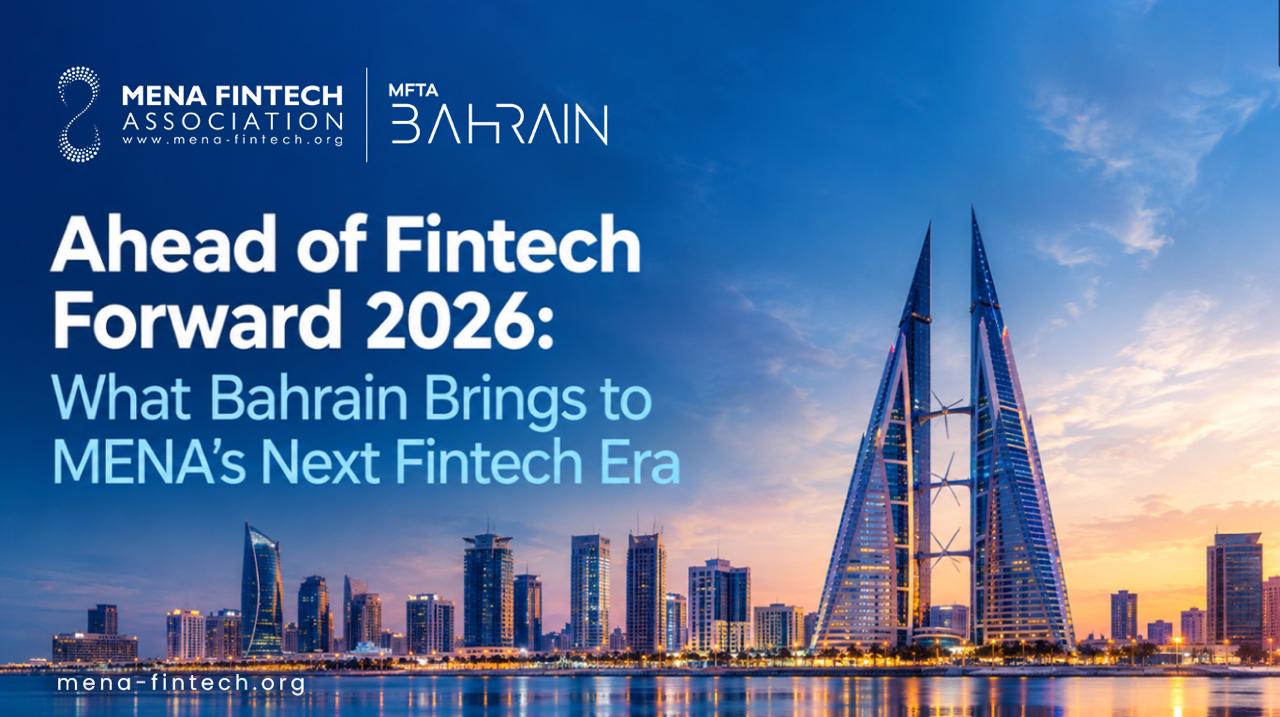
Against that backdrop, Bahrain presents an interesting case. It cannot compete with the region’s largest economies on domestic market size, nor does it attract the same absolute volume of venture capital. Its fintech proposition rests elsewhere: an established financial system, a regulator accustomed to working with emerging technologies and a relatively compact market in which financial products can be tested and commercialised before companies look outward. That makes the theme of this year’s Fintech Forward, taking place in Bahrain on 7–8 October, ‘Finance in the Age of Intelligent Infrastructure’, particularly apt. As the industry gathers in the Kingdom, the bigger question is not whether fintech has a place there, but what Bahrain can do with the infrastructure it has spent years building.
Bahrain’s fintech story started with finance
Much of the conversation around fintech hubs begins with startups. Bahrain’s story begins much earlier, with banking. Financial services accounted for 17.2% of Bahrain’s economy in 2024, according to Bahrain’s Ministry of Finance and National Economy, making it the largest contributor to GDP. The significance of that number becomes clearer when viewed against the country’s wider diversification. Bahrain’s real economy grew by 2.6% in 2024 even as oil output contracted, while its non-hydrocarbon economy expanded by 3.7%. Financial services were the largest contributor to that non-oil growth. The IMF expects economic growth to reach 3.3% in 2026, supported partly by continued activity in finance, tourism, logistics and the digital economy. That gives fintech companies something that a newly created technology ecosystem cannot easily manufacture: proximity to an existing financial industry.
The second piece has been regulation. Bahrain launched the region’s first onshore regulatory sandbox in 2017 and has continued to broaden the areas in which the Central Bank of Bahrain (CBB) engages with financial technology. Its regulatory work now reaches beyond basic digital payments into open banking, crowdfunding, artificial intelligence and cybersecurity.
Tarabut, the sandbox’s first graduate, is a clear example of how that relationship can work. Its path from Bahrain’s regulatory environment into open-banking infrastructure illustrates what a small market can offer: a place to develop a regulated financial product and then build beyond the domestic opportunity. A fintech-friendly jurisdiction is relatively easy to advertise. An ecosystem capable of taking a financial product from experimentation to regulatory approval and commercial deployment is much harder to construct.
The real market is bigger than Bahrain
There is an obvious limitation to Bahrain’s fintech proposition. Its population was around 1.59 million in 2024, a fraction of its larger neighbours, and Saudi Arabia and the UAE dominate much of the region’s fintech investment. Trying to compete with those markets purely on scale would make little sense. The more interesting possibility is that Bahrain does not need to.
The Bahrain Economic Development Board (EDB) positions the country as an entry point into a GCC market worth roughly $2.15 trillion. For a fintech business, that positioning translates into something concrete. A company can establish itself, understand the regulatory requirements, access financial institutions, prove its product commercially and then take what it has built into larger markets.
Bahrain already has pieces of that chain. Open finance is one example. Payments remained the most active fintech segment by deal count across MENA during the first half of 2026, despite a 45% fall in the number of payments funding deals from the previous year. Yet the payments conversation itself is becoming broader. The market is moving beyond the wallet on a consumer’s phone toward account-to-account payments, bank connectivity, data portability, embedded finance and services built on top of open financial data. For companies working at that layer, the size of the first consumer market is not necessarily the only consideration. Access to banks, APIs, licences and interoperable systems can be just as consequential.
Artificial intelligence adds another layer. AI in financial services is no longer limited to a chatbot answering customer questions. Models can influence fraud detection, credit assessment, compliance processes, customer verification and increasingly complex operational decisions. The CBB’s inspection framework explicitly covers AI and machine-learning models alongside real-time fraud assessment systems and open banking, fintech, and InsurTech firms. That signals how quickly the boundary between ‘fintech’ and ordinary financial infrastructure is disappearing.
There is also a particularly Gulf dimension to the opportunity. Islamic finance gives Bahrain a financial specialism that can intersect with new technology in areas ranging from digital investment products to payments and financing. Fintech Forward itself has increasingly brought Islamic fintech into the same conversation as open banking, AI, embedded infrastructure and digital payments. The potential is not limited to Bahrain’s domestic audience; products designed around Sharia-compliant financial structures can address markets across the Gulf and further into the Muslim world.
None of this guarantees regional scale. It does show why Bahrain’s relatively small size does not automatically make it irrelevant in a fintech landscape dominated by much larger economies.
From fintech applications to financial infrastructure
The first era of MENA fintech changed how people interacted with financial services. Payments moved onto phones, onboarding became digital and financial products that once belonged almost exclusively to banks began appearing through new platforms.
The next era is moving underneath those interfaces. Open finance, AI, digital identity, embedded payments, tokenisation and automated compliance increasingly concern the systems through which finance itself operates. That is precisely the shift this year’s theme points to. Bahrain has already spent years working on many of the less visible components needed for that transition: regulatory experimentation, open banking, digital financial services and links between new entrants and an established banking sector. The task ahead is keeping cybersecurity, consumer protection and resilience in step with that pace of innovation, a balance the CBB has built its approach around.
Bahrain has little reason to reproduce Riyadh or Dubai on a smaller scale. Saudi Arabia’s domestic market gives fintech companies an enormous customer opportunity. The UAE combines capital, international talent and a dense technology ecosystem. Bahrain’s case is more specialised: it can make the interaction between regulators, financial institutions and financial technology unusually workable. If that specialisation helps companies reach larger markets, Bahrain’s size becomes less of a constraint.
The harder test now is commercial rather than conceptual. Bahrain has already demonstrated that fintech companies can enter a sandbox, receive licences and operate within its financial system. What matters next is whether that environment can repeatedly produce businesses and technologies capable of travelling beyond the Kingdom. Bahrain needs more than a pipeline of interesting fintech experiments. It needs companies capable of becoming part of the region’s financial architecture. For Bahrain, that may be the most important measure of the next phase of fintech: not how many companies it can attract to experiment, but how many can build there and then scale across MENA.
Interested in knowing more? Reach out to us at marketing@mena-fintech.org
Become a part of the MENA Fintech Association: