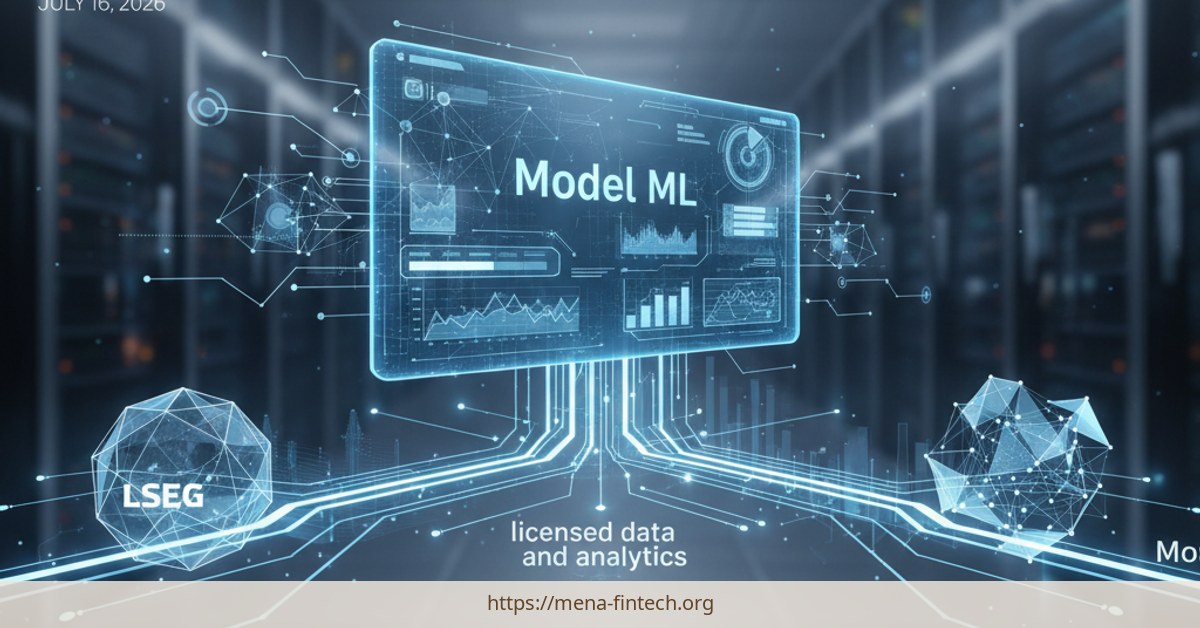
LSEG announced on July 16, 2026, the integration of its licensed financial data and analytics into its AI workflow automation platform.
Integration Details
LSEG’s licensed data and analytics are now available in Model ML through the Model Context Protocol (MCP) connector. This integration enables secure access to AI-ready financial content within financial services workflows. The Model Context Protocol, described in LSEG’s technical documentation, establishes a standardized interface for financial data to be consumed by AI systems. This development positions LSEG as a key provider of infrastructure for firms seeking to automate data processing and decision-making in financial services. The MCP connector, a critical component of the integration, ensures that financial institutions can seamlessly incorporate real-time market data, risk metrics, and analytics into their machine learning models without requiring extensive customization. This standardization reduces friction in data integration, a common bottleneck in AI deployment for financial services.
The technical architecture of the MCP aligns with industry standards for data interoperability, leveraging RESTful APIs and secure token-based authentication to ensure compliance with evolving cybersecurity protocols. This approach is particularly relevant in the MENA region, where financial institutions are increasingly adopting hybrid cloud environments to balance regulatory requirements with operational agility. By embedding LSEG’s data directly into AI workflows, firms can avoid the latency and complexity of manual data aggregation, which has historically hindered the scalability of AI applications in finance.
Market Implications
The integration could influence operational strategies for fintech companies in the MENA region. By embedding licensed financial data directly into AI workflows, firms may reduce latency in data access and improve the accuracy of predictive analytics. This aligns with broader trends in the MENA fintech sector, where companies are increasingly leveraging AI to enhance operational efficiency and data utilization. For example, banks and neobanks in the UAE and Saudi Arabia have shown growing interest in AI-driven credit scoring and fraud detection systems that rely on real-time data feeds. The ability to process high-frequency market data through the MCP connector could enable these institutions to refine their algorithms for dynamic risk assessment, particularly in sectors like trade finance and cross-border payments, where speed and accuracy are critical.
In the GCC, where digital transformation initiatives are accelerating, this integration may also support the expansion of embedded finance models. By providing a unified data layer, LSEG’s platform could facilitate the development of AI-powered tools for personalized financial services, such as robo-advisory platforms and automated loan underwriting. This is particularly relevant in markets like Bahrain and Qatar, where regulatory sandboxes are actively testing AI applications in financial inclusion and SME lending. The integration also addresses a key pain point for regional fintechs: the lack of access to high-quality, standardized data sets that are essential for training robust AI models.
Regulatory Considerations
The integration may raise questions about regulatory compliance in financial services. Data security measures associated with the Model Context Protocol will be crucial for firms utilizing this integration. Regulators in the GCC, including the UAE’s Central Bank and Saudi Arabia’s SAMA, have emphasized the need for robust data governance frameworks as AI adoption accelerates. LSEG’s documentation highlights encryption and access controls as core components of the MCP, but the extent to which these align with regional regulatory requirements remains to be seen. For instance, the UAE’s Data Protection Law (Federal Decree Law No. 45 of 2021) mandates strict safeguards for personal and financial data, while Saudi Arabia’s National Data Management Office (NDMO) is developing a unified framework for cross-sector data governance.
The integration’s compliance with these frameworks will be a critical factor in its adoption by regional institutions. While LSEG’s emphasis on encryption and tokenization addresses some regulatory concerns, the absence of explicit alignment with GCC-specific data localization rules could pose challenges. For example, the UAE requires data related to residents to be stored within the country, a requirement that may necessitate additional infrastructure or partnerships for firms using LSEG’s platform. Similarly, SAMA’s guidelines on AI in financial services stress transparency and accountability, which may require LSEG to provide detailed audit trails for data usage—a feature not explicitly mentioned in the current announcement.
Significance
For MENA fintech, the announcement reflects the continued convergence of payment infrastructure, digital assets, and AI-driven analytics. It also points to a model in which data providers seek to integrate with financial institutions rather than replace them outright. This collaborative approach aligns with the region’s broader push toward ecosystem-driven innovation, where incumbents and disruptors coexist through shared infrastructure. For regional financial institutions, the practical question will be whether the joint venture can translate its corridor and tokenization plans into licensed, bank-compatible services across multiple jurisdictions. Until specific approvals, partners, and launch volumes are disclosed, the development is best treated as an infrastructure initiative to monitor rather than a completed market rollout.
The integration also underscores the growing importance of data as a strategic asset in the MENA fintech ecosystem. As AI adoption accelerates, firms that can access high-quality, standardized data will gain a competitive edge in developing predictive models for credit risk, market trends, and customer behavior. However, the success of this integration will depend on LSEG’s ability to navigate the complex regulatory landscape of the GCC and demonstrate value through measurable improvements in operational efficiency for its clients.
What wasn’t disclosed
The announcement did not disclose investment size, ownership terms, regulatory approvals, named banking partners, launch markets, or committed transaction volumes. It also did not confirm when the first live corridor or commodity product would move into production.