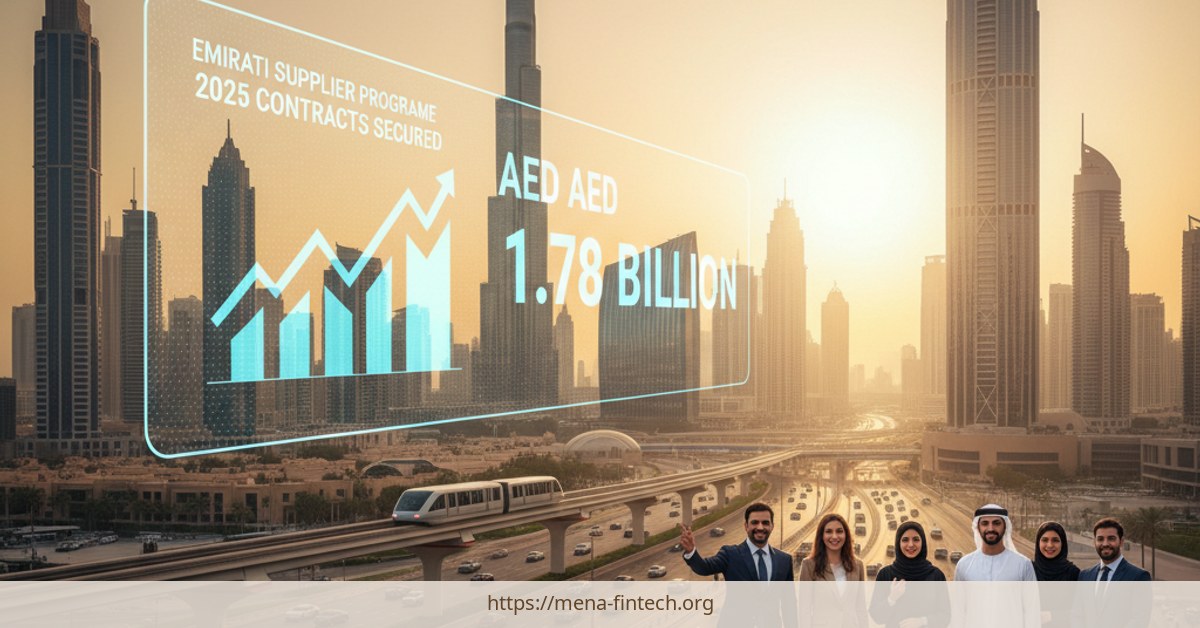
Dubai SME has recognized various entities for their contributions to the Emirati Supplier Programme, facilitating contracts worth AED 1.78 billion for Emirati businesses in 2025. This represents a 38% increase from the previous year.
Significance of the Emirati Supplier Programme
The recognition event, attended by Sheikh Hamdan bin Mohammed, underscores the UAE government’s commitment to supporting local suppliers and fostering economic growth. The Emirati Supplier Programme aims to strengthen the domestic supply chain by prioritizing Emirati-owned businesses in government and semi-government procurement processes. This initiative aligns with broader economic diversification goals, including the UAE’s Vision 2021 and 2030 strategies, which emphasize reducing reliance on oil and boosting private-sector participation. By embedding Emirati businesses into procurement frameworks, the program seeks to enhance local capacity, create jobs, and ensure sustainable economic development. The event also highlights the role of high-level stakeholders in driving policy implementation, as the presence of Sheikh Hamdan bin Mohammed signals the program’s alignment with national priorities.
Trends in Supplier Contracts
The 38% year-over-year growth in contract value highlights a significant acceleration in the program’s impact. Government and semi-government entities have played a pivotal role in driving this growth by actively sourcing from Emirati suppliers. The increase reflects improved access to financing, capacity-building programs, and streamlined procurement processes introduced by Dubai SME. These measures have enabled local businesses to meet the technical and financial requirements of large-scale contracts, which were previously dominated by foreign suppliers. However, the announcement did not disclose specific sectors benefiting most from the contracts or the names of recognized entities beyond their general roles in the program. The lack of sector-specific data limits immediate analysis of which industries are leading the charge, though construction, energy, and technology are commonly cited as areas of focus in UAE economic planning.
Significance: Block
For the UAE fintech and business ecosystem, the Emirati Supplier Programme’s success demonstrates the potential of public-private partnerships in scaling local enterprises. The practical question for market participants is how regional financial institutions and procurement bodies can replicate this model to further embed Emirati suppliers into broader supply chains, particularly in sectors like construction, energy, and technology. The program’s emphasis on capacity-building and financing also offers a blueprint for other Gulf Cooperation Council (GCC) nations seeking to localize their economies. However, challenges remain, including ensuring equitable access to contracts across regions and sectors, and maintaining transparency in the allocation process. The absence of detailed sectoral breakdowns raises questions about the program’s long-term sustainability and its ability to adapt to evolving market demands.
What Wasn’t Disclosed
The announcement did not specify the names of recognized entities, the exact sectors receiving contracts, or the mechanisms for future contract allocation. It also did not confirm whether the AED 1.78 billion figure includes both completed and pending contracts. Additionally, the criteria for selecting recognized entities, the duration of the program’s current phase, and potential benchmarks for future growth were not addressed. These gaps leave room for further inquiry into how the program will evolve and how its success will be measured in subsequent years.
Sources
- Dubai SME Recognises Entities Behind AED 1.78B in Emirati Supplier Contracts – menastartupdigest.com