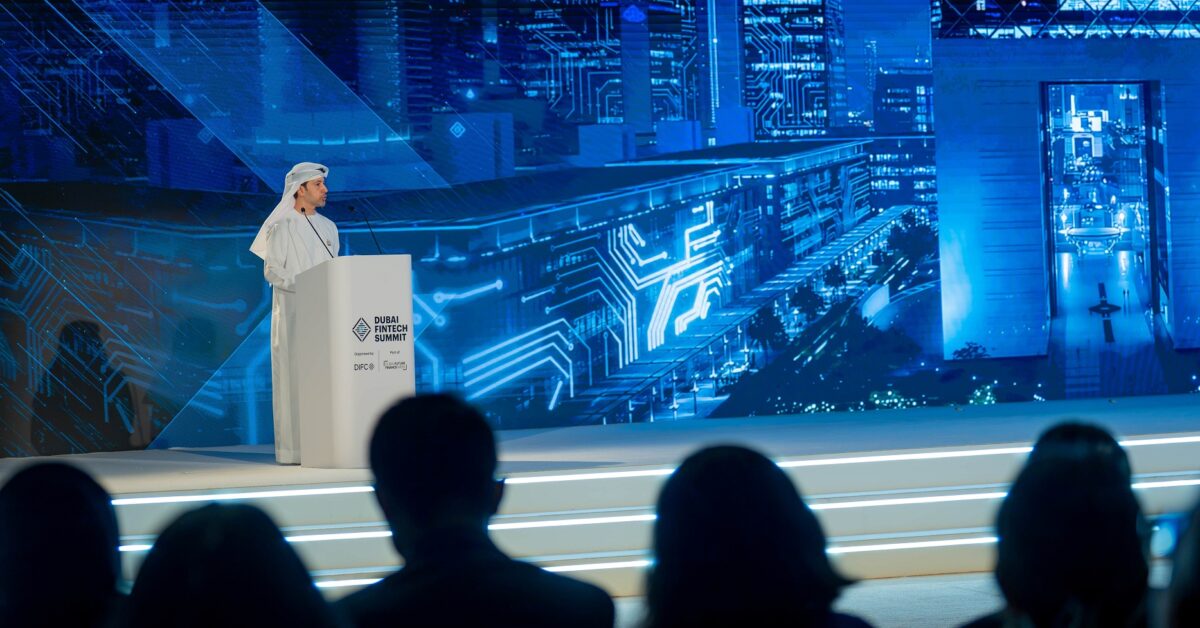
The Dubai Fintech Summit has reached a significant milestone, with the Dubai International Financial Centre (DIFC) now home to more than 2,000 AI, fintech and innovation firms. This achievement marks a major step forward for the centre, which has grown from just 11 startups in its first accelerator in 2017. According to His Excellency Arif Amiri, chief executive of DIFC Authority, the focus is on helping these firms grow into global leaders.
A new partnership will provide up to 6,000 Japanese startups with direct access to the DIFC ecosystem, as part of a broader push into emerging markets and new corridors with the Global South. Additionally, DIFC will launch a Dubai Fintech Stack, a set of tools designed to assist founders with onboarding, payments, risk, security, and AI. These initiatives aim to further establish DIFC as a hub for fintech innovation.
What the future holds for AI and fintech
The digital economy is undergoing a significant shift, moving from digitising processes to systems that can act autonomously. According to Michael Lawrence, chief executive of Asia House, global technology spending stands at USD 5.6trn this year, with AI expected to add USD 22.3trn to the world economy by 2030. The fintech market is also growing, from around USD 400bn today to USD 1.5trn. Dubai is poised to play a key role in this growth, alongside other major hubs such as Singapore and Switzerland's Zug and Zurich.
Noel Quinn, chair of Julius Baer and former group chief executive of HSBC, emphasized the importance of tokenisation as a natural evolution rather than a revolution. He stressed the need to separate the blockchain from the products built on it, and to focus on opening up assets such as bonds, gold, and trade finance to investors who previously lacked access. Quinn also highlighted the potential of AI in banking, citing its ability to screen payments for money laundering and sanctions.
Banks embracing AI
Emirates NBD has made significant strides in AI adoption, with over 150 initiatives under way and 65 already in production. The bank's customers are now answered by AI agents, and an AI-powered agent will soon replace the menus in the ENBD X app. Miguel Rio-Tinto, who leads digital and technology at Emirates NBD, noted that the bank builds and orchestrates its customer journeys itself, with a team of 2,500 software engineers. However, the bank partners with other companies for frontier models and computing power.
The Central Bank of the Republic of Türkiye has also made notable progress in its economic recovery, with reserves rebuilt and USD 140bn of FX-protected deposit liabilities reduced to zero. Dr. Fatih Karahan, the bank's governor, emphasized the importance of payment sovereignty and the need for instant payment systems. He also announced Turkey's plans to join SEPA and SWIFT's new instant payments scheme.
The future of commerce
Zand Bank is preparing for a future where AI agents will play a major role in commerce. The bank's chief executive, Michael Chan, explained that these agents will be able to pay each other using stablecoins, with transactions recorded on a blockchain. This concept, known as agentic commerce, is expected to arrive within the next 12 months. Chan believes that the main obstacle to overcome is not technical, but rather the need for synchronisation and alignment between different jurisdictions.
- DIFC is now home to over 2,000 AI, fintech and innovation firms
- A new partnership will provide Japanese startups with access to the DIFC ecosystem
- The digital economy is shifting towards autonomous systems
- Banks are increasingly embracing AI and tokenisation
The Dubai Fintech Summit has highlighted the significant progress being made in the fintech sector, with a focus on AI, tokenisation, and innovation. As the industry continues to evolve, it is likely that we will see even more exciting developments in the future. With the DIFC at the forefront of this growth, Dubai is poised to remain a major hub for fintech innovation.