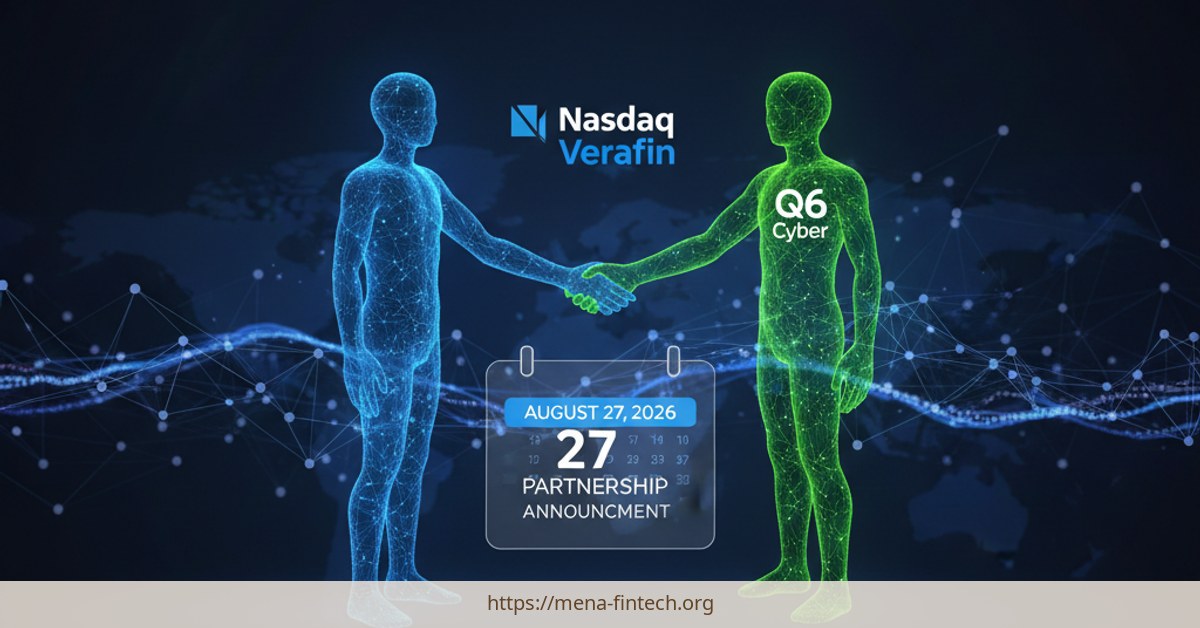
Nasdaq Verafin announced a partnership with Q6 Cyber on August 27, 2026, to enhance fraud detection capabilities for financial institutions.
Partnership Overview
The collaboration aims to integrate Q6 Cyber’s dark web fraud intelligence with Verafin’s consortium data insights, providing a comprehensive tool for identifying and responding to emerging fraud threats. The integrated platform will help financial institutions proactively detect and mitigate risks associated with scams and fraudulent activities. This partnership leverages Verafin’s extensive network of financial institutions, which shares anonymized transaction data across a consortium model, and Q6 Cyber’s real-time monitoring of dark web forums, marketplaces, and illicit communication channels. By combining these two data streams, the solution is designed to flag suspicious patterns that might otherwise go undetected by traditional fraud detection systems. For example, synthetic identity fraud—where criminals combine real and fake data to create new identities—can be identified earlier by cross-referencing dark web activity with transactional anomalies detected through consortium data.
Significance of Enhanced Fraud Detection
For the global fintech ecosystem, this partnership underscores the growing need for advanced fraud detection mechanisms as cybercriminals increasingly exploit dark web networks to orchestrate sophisticated scams. Enhanced detection capabilities could improve consumer trust in digital financial services, particularly as financial institutions face mounting pressure to protect user data and prevent unauthorized transactions. The integration of dark web intelligence into fraud analytics represents a shift from reactive to proactive fraud management, enabling institutions to intercept threats before they materialize into losses. This is especially critical in the MENA region, where digital banking adoption is accelerating, and cross-border payment systems are expanding. According to Nasdaq Verafin’s documentation, the consortium model already processes billions of transactions annually, providing a robust foundation for detecting anomalies at scale. Q6 Cyber’s focus on dark web intelligence, which includes monitoring over 10,000 illicit websites and forums, adds a layer of predictive capability to this existing infrastructure.
The partnership addresses a critical gap in the financial sector’s ability to respond to evolving fraud tactics. By combining real-time dark web monitoring with consortium-level transaction data, the solution offers a layered defense against emerging threats, including synthetic identity fraud and account takeover schemes. This dual-layer approach is particularly relevant in the GCC, where financial institutions are under increasing regulatory scrutiny to adopt advanced cybersecurity measures. For instance, the UAE’s Central Bank has mandated that banks implement AI-driven fraud detection systems by 2027, a requirement that this partnership could help institutions meet. The integration also aligns with the broader trend of embedding cybersecurity into financial infrastructure, a priority highlighted in the Saudi Arabian Vision 2030 framework.
Market Implications
While the partnership is not directly tied to the MENA region, its implications for the broader fintech landscape are significant. As financial institutions in the GCC and beyond adopt more digital-first strategies, the integration of dark web intelligence into fraud detection systems could become a standard requirement for compliance with international anti-fraud regulations. The collaboration may also influence future partnerships between fintech firms and cybersecurity companies, particularly in regions where digital banking adoption is accelerating. For example, the Gulf Cooperation Council (GCC) has seen a 40% year-over-year increase in digital banking users, according to a 2025 report by the Arab Monetary Fund. This growth trajectory underscores the urgency for institutions to adopt solutions that can scale with demand while maintaining compliance with evolving regulations.
However, the announcement did not disclose financial terms, expected merchant volumes, or specific regulatory approvals required for deployment in the MENA market. This lack of detail raises questions about the timeline for regional implementation and the adaptability of the joint venture’s model to local regulatory frameworks. For instance, while the UAE’s regulatory environment is relatively progressive, other GCC countries may require additional safeguards or data localization measures that could delay deployment. The absence of named banking partners or launch markets also leaves uncertainty about the initial scope of the partnership’s impact in the region.
What Wasn’t Disclosed
The partnership announcement did not specify investment size, ownership terms, regulatory approvals, named banking partners, launch markets, or committed transaction volumes. It also did not confirm when the first live fraud detection corridor or product would move into production. These omissions are notable given the strategic importance of the collaboration. For example, the lack of named regional partners could indicate that the partnership is still in its early stages of deployment, or that the companies are prioritizing global rollout before focusing on MENA-specific initiatives. Additionally, the absence of financial terms may suggest that the partnership is structured as a non-equity collaboration, which is common in the fintech sector to minimize risk for both parties.
Nasdaq Verafin’s own documentation describes the network around tokenization, consortium data sharing, and fraud analytics. Q6 Cyber’s website highlights its focus on dark web intelligence and threat detection, aligning with the stated goals of the joint venture. However, the absence of detailed technical specifications or use cases for the integrated platform leaves room for speculation about its practical applications. For instance, it remains unclear whether the solution will be offered as a standalone product or integrated into existing fraud detection systems used by banks in the region.
Significance:
For MENA fintech, the partnership reflects a broader trend toward integrating cybersecurity solutions into financial infrastructure, particularly as digital banking and cross-border payment systems expand. The collaboration positions dark web intelligence as a critical layer in fraud prevention strategies, which could influence how regional institutions approach compliance with international anti-fraud frameworks. This is especially relevant in the context of the European Union’s proposed Digital Operational Resilience Act (DORA), which could indirectly impact MENA financial institutions through cross-border regulatory alignment.
For regional financial institutions, the practical question is whether the joint venture’s model can be adapted to meet local regulatory requirements while maintaining the scalability needed for cross-border operations. Until specific approvals, partners, and launch volumes are disclosed, the development is best treated as an infrastructure initiative to monitor rather than a completed market rollout. The partnership’s success in the MENA region will depend on its ability to navigate the complex regulatory landscape and demonstrate measurable value in reducing fraud losses, which are estimated to cost the global financial sector over $40 billion annually, according to a 2026 report by the Financial Fraud Action UK.