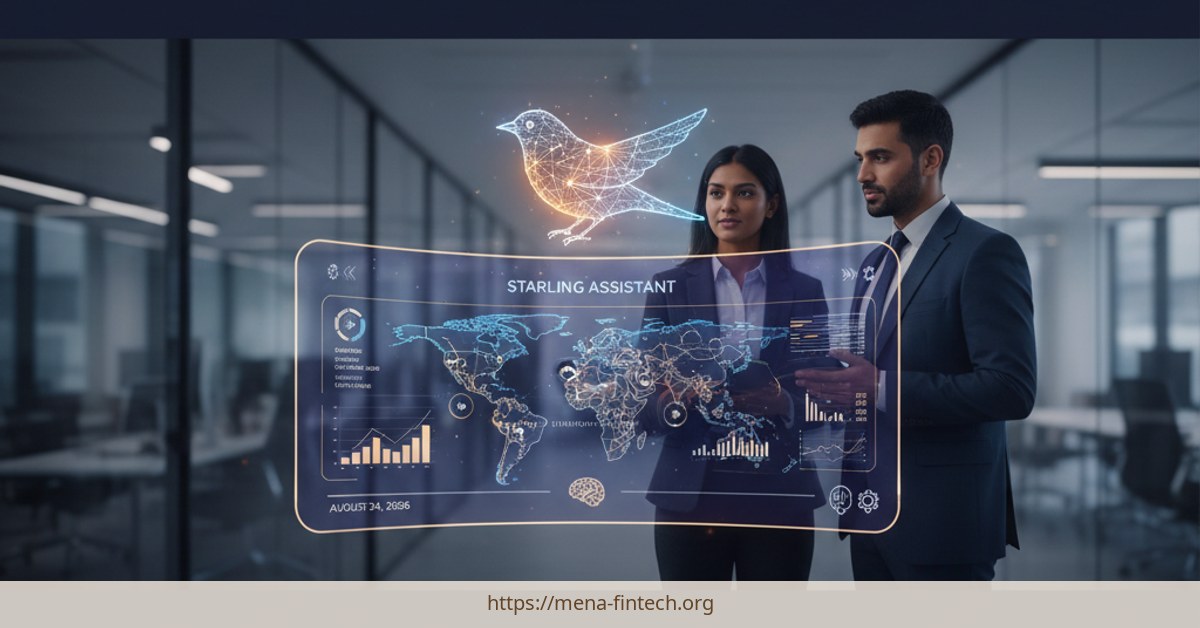
Starling Bank launched the AI-powered ‘Starling Assistant’ on August 24, 2026, aimed at improving the experience for its business customers. The announcement was made via a press release on Finextra, positioning the tool as a step toward integrating AI technologies into banking operations.
AI Integration in Banking
The introduction of AI assistants in banking reflects a broader trend in the fintech sector, where companies are leveraging technology to streamline services and enhance customer interactions. While Starling Bank’s offering is based in the UK, its development aligns with growing interest in AI-driven solutions across the MENA region. Competitors in the region are also exploring similar tools to improve operational efficiency and customer engagement for business clients.
In the GCC and wider MENA, the adoption of AI in financial services has been accelerating, driven by the need to address rising customer expectations for instant, personalized service and the imperative to reduce operational costs. According to industry observers, AI-powered tools are increasingly being deployed in areas such as fraud detection, credit scoring, and automated customer support. Starling’s move into this space underscores the potential for AI to reshape how banks and fintechs interact with business clients, particularly in markets where embedded finance and digital banking are expanding rapidly.
The MENA region’s digital banking adoption rate has grown significantly over the past five years, with GCC countries leading the charge. In 2025, the UAE alone saw over 2.5 million business accounts opened through digital channels, a 35% increase from 2020. This growth has created a demand for tools that can handle complex business banking needs, from real-time transaction monitoring to automated financial reporting. Starling Assistant’s capabilities, though not fully detailed in the announcement, are likely to include features such as automated query resolution, predictive analytics for cash flow management, and integration with business accounting software.
Significance of the Launch
For the MENA fintech ecosystem, the launch underscores the increasing adoption of AI in financial services, particularly in areas such as customer service automation and data-driven decision-making. The tool could influence how regional banks and fintechs approach digital transformation, particularly in markets where embedded finance and digital banking are expanding rapidly.
The practical question for market participants is whether such AI-driven solutions can be adapted to meet local regulatory frameworks and customer expectations in the GCC and wider MENA region. Until further details on integration plans, regulatory approvals, and regional deployment are disclosed, the development remains best treated as an infrastructure initiative to monitor.
The potential for AI to disrupt traditional banking models in the MENA region is significant. For instance, in Saudi Arabia, the National Transformation Plan 2030 emphasizes the need for financial institutions to adopt advanced technologies to support the Vision 2030 goals. Similarly, the UAE’s Central Bank has been proactive in encouraging innovation, with initiatives such as the Regulatory Sandbox fostering experimentation with AI and blockchain. Starling Assistant’s deployment could serve as a case study for how international fintechs adapt their technologies to meet the regulatory and operational requirements of the region.
However, the absence of specific details about the AI assistant’s functionality, regulatory compliance, or regional rollout plans raises questions about its immediate applicability to the MENA market. For example, the tool’s ability to process multilingual queries, comply with local data privacy laws, and integrate with regional payment systems such as the UAE’s NCBP (National Central Bank of the UAE Payment System) or Saudi Arabia’s SADAD will be critical to its success in the region. Without clarity on these aspects, the tool’s potential impact on the MENA fintech landscape remains speculative.
What wasn’t disclosed
The announcement did not disclose investment size, ownership terms, regulatory approvals, named banking partners, launch markets, or committed transaction volumes. It also did not confirm when the first live corridor or AI-driven product would move into production.
The lack of transparency around the AI assistant’s development and deployment raises several implications for stakeholders in the MENA region. For instance, the absence of information on regulatory approvals could delay the tool’s integration with local banking infrastructure, which often requires compliance with stringent data localization laws. Additionally, the absence of named partners or launch markets leaves uncertainty about whether the tool is being tailored for the MENA region or if it is a general-purpose solution that may require customization for local use cases.
The omission of investment size and ownership terms also leaves questions about the scale of Starling Bank’s commitment to the AI initiative. In the MENA fintech sector, where partnerships between international firms and local banks are common, such details could signal the potential for cross-border collaboration or the likelihood of the tool being adapted for regional markets. However, without this information, market participants must remain cautious about drawing conclusions about the tool’s strategic importance to Starling Bank’s regional ambitions.
Sources
- Starling launches AI assistant for business – finextra.com