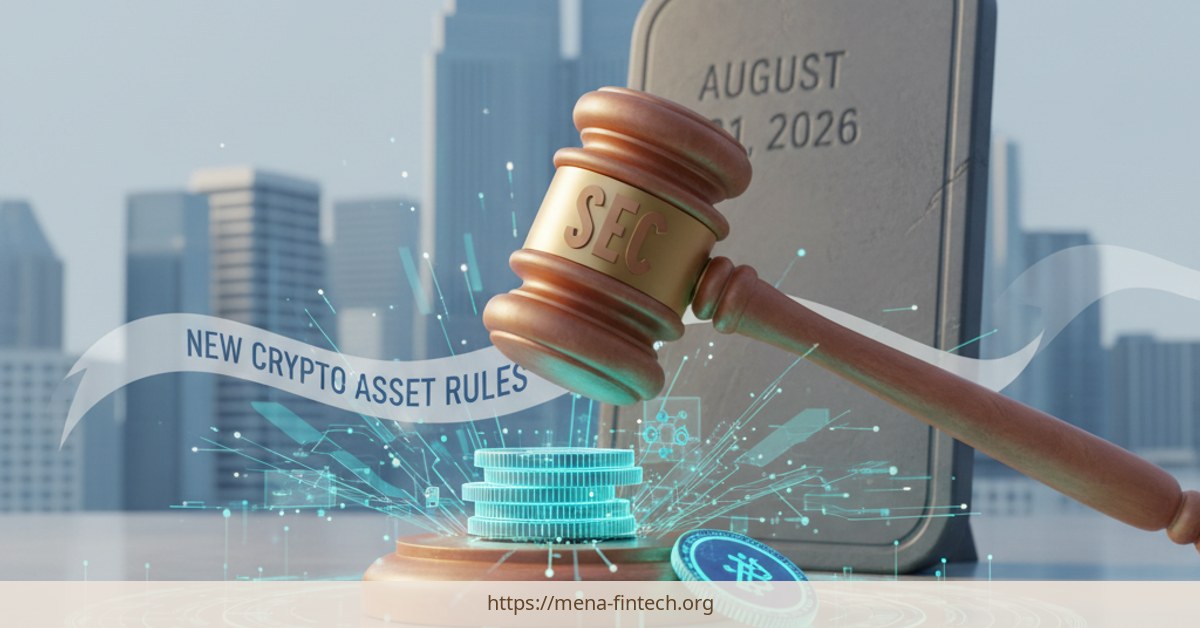
The U.S. Securities and Exchange Commission (SEC) announced its proposal of new crypto asset rules on August 21, 2026, aiming to establish a framework for investment contracts involving digital assets. The move seeks to provide clarity and oversight in the rapidly evolving crypto market, which could influence fintech operations and regulatory responses in the Middle East and North Africa (MENA) region.
Proposed Regulations Overview
The SEC’s proposed regulations focus on defining and regulating investment contracts involving digital assets. According to the announcement, the framework aims to address gaps in oversight while ensuring investor protection. The rules emphasize the classification of crypto assets as securities in certain contexts, which would subject them to existing regulatory frameworks. This classification aligns with the SEC’s long-standing interpretation of the Howey Test, which defines an investment contract as a transaction involving an investment of money in a common enterprise with the expectation of profit derived from the efforts of others. By extending this test to digital assets, the SEC seeks to bring clarity to a market that has operated largely in regulatory ambiguity. The proposed rules would require issuers of crypto assets to register with the SEC, disclose material information, and comply with anti-fraud provisions. This would mirror existing requirements for traditional securities, potentially reducing the risk of unregistered offerings and deceptive practices. However, the framework does not explicitly address the classification of stablecoins or non-security tokens, leaving room for further interpretation and potential disputes.
Regional Implications for MENA Fintech
The proposed U.S. regulations may present both challenges and opportunities for MENA fintech companies. Potential challenges include aligning with U.S. compliance standards for firms operating in or partnering with American markets. This could increase operational complexity for regional startups and established players engaged in cross-border transactions. For instance, MENA-based crypto exchanges or wallet providers that facilitate U.S. dollar transactions may need to restructure their compliance programs to meet SEC registration and disclosure requirements. This could involve significant legal and operational costs, particularly for smaller firms with limited resources. Conversely, the SEC’s actions may prompt MENA regulators to accelerate the development of localized frameworks tailored to the region’s financial ecosystem. Gulf Cooperation Council (GCC) countries, which have been exploring digital asset policies, could use this as a catalyst to refine their own regulatory approaches. For example, the UAE’s Dubai Financial Services Authority (DFSA) has been experimenting with regulatory sandboxes for blockchain innovation, while Saudi Arabia’s Central Bank has been cautious in its approach to crypto, emphasizing financial stability. The SEC’s proposal may encourage these regulators to adopt more structured frameworks, balancing innovation with investor protection. Additionally, the move could spur collaboration between MENA fintechs and international partners, as regional companies seek to align with global standards to access larger markets. This could lead to increased investment in MENA’s fintech sector, as investors perceive a more predictable regulatory environment.
What Wasn’t Disclosed
The SEC’s announcement did not specify timelines for implementation or enforcement mechanisms for the proposed rules. This lack of detail leaves uncertainty about how swiftly the regulations might take effect and how they will be applied in practice. Additionally, the proposal did not address how U.S. rules might interact with existing or emerging regulatory sandboxes in the MENA region. For example, the UAE’s sandbox allows fintechs to test innovative products under regulatory supervision, but it remains unclear whether U.S. securities laws would override or complement such frameworks. Similarly, the absence of guidance on enforcement raises questions about how the SEC will monitor compliance, particularly for cross-border transactions involving MENA entities. The proposal also does not clarify the treatment of stablecoins, which are widely used in the region for remittances and e-commerce. This ambiguity could lead to regulatory arbitrage, where firms exploit differences in oversight between jurisdictions. Furthermore, the lack of a clear transition period for existing crypto projects may create compliance risks, as companies may struggle to adapt to new requirements without sufficient time or resources. These gaps highlight the need for further dialogue between U.S. regulators and MENA counterparts to ensure harmonization and avoid fragmentation in the global crypto regulatory landscape.
SEC, crypto regulations, MENA fintech, digital assets, investment contracts, regulatory clarity.
Sources
- SEC proposes Regulation Crypto Assets – finextra.com