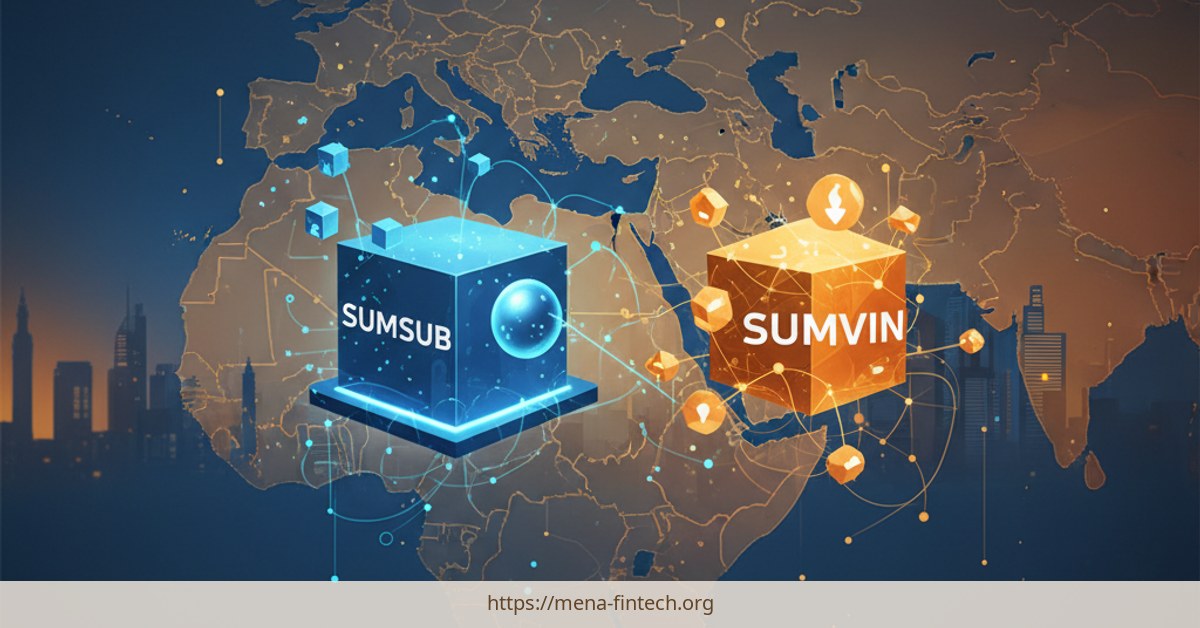
Sumsub and Sumvin have partnered to allow AI agents to conduct transactions for users verified through Know Your Customer (KYC) processes.
The collaboration between Sumsub, a global identity verification platform, and Sumvin, a market-leading agentic commerce platform, introduces a framework where AI agents can complete purchases and manage financial accounts on behalf of users who have undergone KYC verification. This development positions the MENA region at the forefront of integrating AI into financial transactions, with potential implications for regulatory frameworks and user trust in automated systems.
Partnership Overview
Sumsub specializes in identity verification solutions, providing tools for financial institutions to comply with anti-fraud and regulatory requirements. Its platforms are widely used across the MENA region to ensure compliance with local and international standards, including those set by the Gulf Cooperation Council (GCC) and the UAE’s Central Bank. Sumvin, on the other hand, operates as an agentic commerce platform, enabling businesses to automate customer interactions through AI-driven processes. This includes managing customer inquiries, processing orders, and executing transactions in real time. The partnership aims to merge these capabilities, allowing AI agents to transact on behalf of users whose identities have been verified through Sumsub’s systems. This integration could streamline financial workflows for users in the MENA fintech ecosystem, particularly in cross-border payments and digital asset management, where speed and compliance are critical.
The MENA region has seen rapid growth in digital transactions, driven by increasing smartphone penetration and a young, tech-savvy population. For instance, the UAE’s Central Bank has reported a 40% year-over-year increase in digital payment volumes, underscoring the region’s readiness for AI-driven financial services. By combining Sumsub’s identity verification with Sumvin’s AI capabilities, the partnership addresses a key pain point: ensuring that automated transactions remain compliant with KYC and anti-money laundering (AML) protocols.
Implications for Fintech Regulation
The integration of AI in financial transactions may prompt regulatory updates in the MENA region, particularly around Know Your Customer (KYC) protocols. Current frameworks emphasize human oversight in verification processes, but this partnership introduces a model where AI could assume some of these responsibilities. For example, AI agents could verify user identities in real time using biometric data or document analysis, reducing the need for manual checks. However, this shift raises questions about accountability and transparency. If an AI agent processes a transaction that later proves fraudulent, who is responsible—the platform, the user, or the AI itself?
Potential regulatory adjustments may include new compliance standards for AI-driven transaction management, ensuring transparency and accountability. For regional financial institutions, the challenge lies in balancing innovation with the need to maintain trust in automated systems, especially in markets where regulatory maturity varies. In countries like Saudi Arabia and the UAE, where digital banking is advancing rapidly, regulators may adopt a phased approach, starting with pilot programs to assess risks before broader implementation. In contrast, other parts of the MENA region may require more time to build infrastructure and public confidence in AI-driven systems.
Challenges and Opportunities
User education on AI transaction management will be critical for adoption. Concerns over data privacy and security may arise, requiring clear communication from both Sumsub and Sumvin about how user data is protected during AI-mediated transactions. For instance, Sumsub’s systems already employ encryption and tokenization to safeguard sensitive information, but the addition of AI agents may necessitate additional safeguards, such as multi-factor authentication or real-time anomaly detection. On the other hand, the partnership presents opportunities for increased efficiency in financial services, reducing manual processing times and enabling real-time transaction approvals. For fintech operators in the GCC, this could accelerate the deployment of AI-driven solutions in areas such as embedded finance and digital wallet ecosystems.
The MENA region’s cross-border payment corridors, particularly between GCC countries and South Asian markets, could benefit significantly from AI-driven transaction automation. For example, remittance services, which account for over $100 billion annually in the region, could see reduced costs and faster processing times through AI integration. However, the success of this model will depend on harmonizing regulatory requirements across jurisdictions, a complex task given the varying legal frameworks in the region.
What wasn’t disclosed in the announcement includes details on investment size, ownership terms, regulatory approvals, named banking partners, launch markets, or committed transaction volumes. The partnership’s timeline for implementation and specific use cases remain unclear, necessitating further updates from both companies. This lack of transparency may pose challenges for stakeholders seeking to assess the partnership’s scalability and long-term viability.
Significance: For the MENA fintech sector, this partnership reflects the growing intersection of AI technology and financial services, particularly in identity verification and transaction management. The model could influence how regional regulators approach AI integration in compliance frameworks, potentially leading to the creation of new standards for AI accountability in financial systems. For financial institutions and startups, the practical question is whether this infrastructure can be scaled into licensed, bank-compatible services across multiple jurisdictions, aligning with existing regulatory priorities in the GCC. The success of this initiative may also set a precedent for other AI-driven fintech innovations in the region, such as automated credit scoring or robo-advisory services.